
How to Tell a Child Their Pet Died
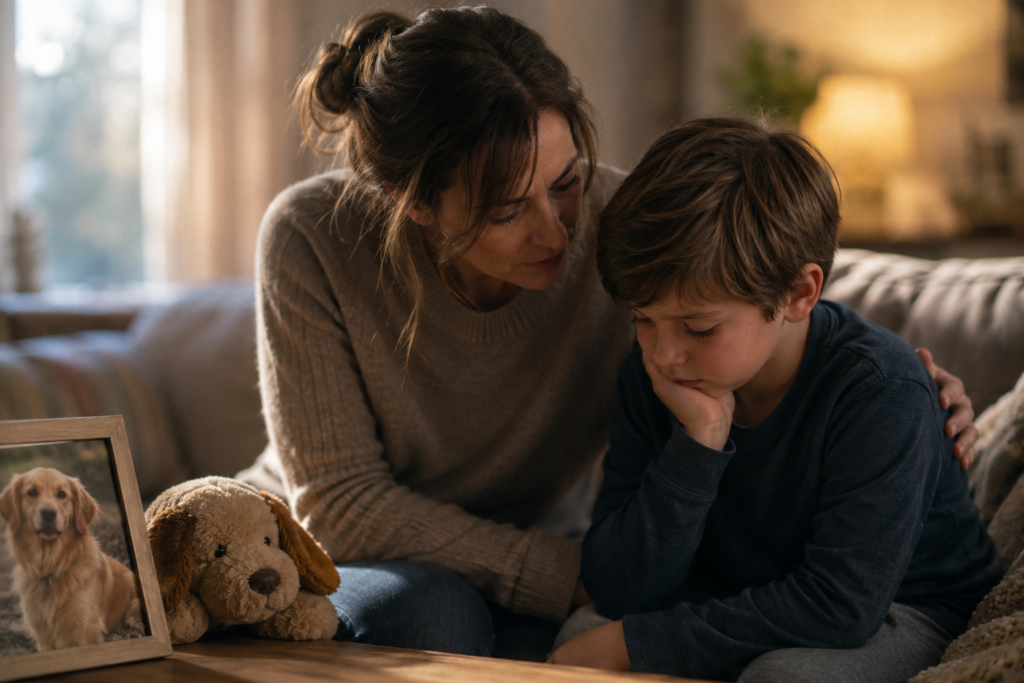
For most children, a pet is the first death they meet. How that conversation goes tends to stay with them, not because you got the words perfect, but because of what it taught them about whether hard things can be talked about.
You are almost certainly going to do this better than you fear.
Use the word “died”
This is the hardest advice to follow and the most important.
Children under about eight are literal thinkers. “We put her to sleep” can become a fear of going to bed. “We lost him” raises the question of why nobody is looking. “He went to live on a farm” tends to unravel eventually, and when it does, the child learns that you will lie to them about serious things.
So: “Max died this morning.” Then stop and let them react.
It feels brutal in your mouth. It isn’t. Clear words give a child something solid to stand on. Soft words leave them guessing, and children fill gaps with something worse than the truth, usually that it was somehow their fault.
What to say, roughly by age
Under five. They won’t understand that death is permanent, and they’ll ask when the pet is coming back, possibly for weeks. Answer the same way each time, calmly: “Bella died. Her body stopped working and it can’t start again. She isn’t coming back.” The repetition isn’t them being difficult. It’s how they process it.
Five to eight. Now they understand permanence, and they want mechanics. Expect questions about what happens to the body, whether it hurt, and whether you will die. Answer plainly and briefly. It’s fine to say “I don’t know” about what happens afterwards, and if your family holds a belief about that, say it as a belief rather than a fact.
Nine to twelve. Often the age of hardest guilt. They may fixate on something they did or didn’t do, left a gate open, didn’t play with him that morning. Ask directly: “Do you think any of this was your fault?” Naming it lets them answer.
Teenagers. They may seem unbothered and grieve privately, or be far more upset than they want you to see. Don’t push. Say clearly that you’re around, and that this is a real loss, then let them come to you. A lot of teenage grief happens sideways, in the car or at 11pm.
Let them see you cry
Parents often work hard to hold it together in front of children. It’s a kind instinct and it teaches the wrong thing.
If you cry and say “I’m sad because I loved her,” a child learns that grief is survivable and speakable. If you leave the room every time, they learn this is something you hide. That lesson lasts far longer than the week they’re in now.
You don’t need to fall apart in front of them. You just don’t need to pretend.
The questions you’ll be asked
“Was it my fault?” No, and say so directly and immediately. Don’t qualify it.
“Will you die?” “Yes, everyone dies eventually. But I’m healthy, and I expect to be here for a very long time.” Reassurance without a promise you can’t keep.
“Where is he now?” If you believe something, say it. If you don’t, “I don’t know for certain. What I do know is he isn’t in pain, and he was loved every day he was here” is a complete and honest answer.
“Can we get another one?” Sometimes asked within an hour, which is normal and not callous, children move between grief and normality quickly. “Maybe one day. Not yet. Right now we’re missing Max.” Don’t treat it as a betrayal.
If you’re choosing euthanasia
Tell them beforehand if there’s time. Being told afterwards can feel like being excluded from something that mattered.
Explain it simply: “The vet is going to help Bella die gently, so she doesn’t have to hurt anymore. It won’t hurt her. It’s very quick.”
Should they be present? There’s no correct answer. Children over about seven who want to be there usually cope fine and are often glad they were. Children who don’t want to be shouldn’t be pushed, and either way, offer the option to see the body afterwards. That’s often what makes it real enough to grieve.
What tends to help afterwards
Children grieve through doing rather than talking. Consider:
– Drawing a picture, or making a small book about the pet
– A box of favourite things, collar, a photo, a toy
– Planting something in the garden
– Writing a letter to say what they didn’t get to say
– A small ceremony, however informal
Expect grief to come in bursts. A child can be sobbing and then asking about dinner ten minutes later. That’s not shallowness, it’s a smaller nervous system taking it in manageable pieces.
When to look for more help
Most children work through this at home. Consider talking to your GP or the school if, after several weeks:
– They’re not sleeping, or having persistent nightmares
– They’ve stopped eating properly or withdrawn from friends
– They’re regressing noticeably, bedwetting, clinginess well beyond their usual
– The guilt hasn’t shifted at all despite reassurance
– They’re anxious that other family members are about to die
Schools deal with this more often than parents expect. Telling the teacher what’s happened is worth doing even if things seem fine.
One last thing
Children take their cue from how the adults around them treat the loss. If the family talks about Bella, keeps her photo up, and says her name out loud, the child learns that people we love stay part of the family after they die.
That’s a useful thing to know, and this is a gentle place to learn it
*If you’re finding this hard yourself, and most parents do, while managing everyone else’s grief, there are (people who understand /support-directory) and a [community here](/stories) who’ve been where you are.*
You don't have to carry this alone.
Others here are going through something similar. Read what they've written, or share your own.
Read community stories
Nobody has replied yet
If this sounded like something you have felt, saying so is worth more than you would think. The person who wrote it will see it.